Research Article | | Peer-Reviewed

Major Feed Resources for Small Ruminant and Traditional Feding Practice in Bursa District of Sidama Region, Ethiopia

Received: 16 November 2024     Accepted: 27 November 2024     Published: 23 December 2024
Views:       Downloads:
Abstract

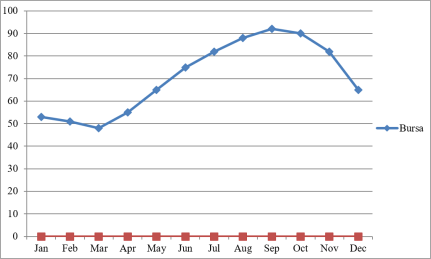
The study was conducted in Bursa districts of the highland areas of Sidama region to Evaluate traditional fattening practice, and availability of major feed resources for small ruminants. For the survey, 92 households were randomly selected by using multi-stage purpose sampling techniques. The survey data were collected on fattening practices, feed availability and constraints related to small ruminant fattening by using structured questionnaires’, field observation, focal group discussion and key informant interviews. Secondary information was obtained from respective districts of livestock development offices. According to the results this study, the major sources of small ruminant for fattening were obtained through purchasing (63.9%) followed by own at home (36.1%) and majority of the farmers fatten small ruminant twice within a year (47%) in 4-6 months (63%). The major available feed resources for small ruminant in the study area were natural pasture, Desho grass, bamboo leaf, enset leaf and barely straw. According to most respondents, the shortage of feed occurred from January to March, While, July to October was considered as months with ample feed resources.

Published in Animal and Veterinary Sciences (Volume 12, Issue 6)
DOI 10.11648/j.avs.20241206.13
Page(s) 161-170
Creative Commons

This is an Open Access article, distributed under the terms of the Creative Commons Attribution 4.0 International License (http://creativecommons.org/licenses/by/4.0/), which permits unrestricted use, distribution and reproduction in any medium or format, provided the original work is properly cited.

Copyright

Copyright © The Author(s), 2024. Published by Science Publishing Group

Keywords

Fattening, Feed Resources, Feeding Systems, Small Ruminant

1. Introduction
The livestock sector is responsible for over half of the agricultural output in the developed world. In developing countries as a whole, it is responsible for a quarter of the output . In the horn of Africa and especially in Ethiopia where the economy is predominantly agriculture-based, Small ruminant and their products play a critical role in the livelihood of millions of farmers and pastoralists. Small ruminants are important components of the livestock subsector and are sources of cash income and play a vital role as sources of meat, milk and wool for smallholder keepers in different farming systems and agro ecological zones of the country. They are also sources of foreign currency .
Ethiopia has the largest livestock population in Africa . According to , 80 percent of smallholder farmers own cattle, 31–38 percent own sheep, and 21–33 percent own goats. Ethiopia is home for diverse indigenous sheep and goat populations, numbering 40 million and 51 million , respectively, parallel to its diverse ecology, production systems and ethnic communities. Rearing of small ruminants plays a very important role in the lives of households in developing countries. This is because small ruminants provide the easiest and most readily accessible source of credit available to meet immediate social and financial obligations. Sheep and goats are an integral part of mixed-farming systems in most parts of the country. These systems, particularly those in the highland areas, are under threat because of shrinking cultivated areas per household, reduced feed availability and land degradation, which are making it difficult to sustain large ruminants .
Small ruminants are widely reared in a crop- livestock farming system and are distributed across different agro ecology zone of Ethiopia. Sheep and Goats fattening is an important activity for small holders, particularly for resource poor famers in many part of the country. Its provide a vast range of products and services such as immediate cash income, meat, milk, skin, manure and social functions . Generally, sheep are the predominant livestock in areas over 3000 meter above sea level (m.a.s.l) and at altitude over 3500 m.a.sl farmers keep more sheep. In Ethiopia, goats are adapted to a wide range of agro-climatic conditions, have selective feeding behavior, fast reproduction, low capital investment making them suitable fort smallholder farmers and pastoralists.
Sheep and goat have a great environment adaptability, short production cycle, faster growth rates, easy management, low investment capital and low feed requirement as compared to large ruminants . Small ruminant are the major economically important livestock in Ethiopia, playing an important role in livelihood of resource poor farmers. They provide their owners with a vast range of products and services such as meat, milk, skin, hair, wool and manure and as means of saving and investment.
Small ruminant fattening in Ethiopia has been recognized as a potential profitable activity that enhances the income of smallholder farmers . Traditionally, farmers in Ethiopia are used to fatten small ruminant based on available inputs targeting sales during festive holidays. This is based on limited scientific and technical knowhow in feeding systems and husbandry practices. It was also suggested that there appears to be a lack of appropriate feed packages to make small ruminant fattening an economically viable system .
Challenges and problems vary from one place to another as well as from one location to another. Generally, in Ethiopia the productivity of small ruminant is disproportional due to low attention of small ruminant development sector, inadequate extension service, knowledge gape of the farmers to adapt technology, poor performance and lack of attention to improve local breeds, technical and nontechnical problems and traditional management system in feeding, housing and watering of small ruminants.
In Bursa district of Sidama, there are various feed resource and feeding system for their Small ruminant. However, this feed resource and feeding system is not technologically assisted. In addition, thought there are ample amount of feed resources in the areas, poor feed resource utilization system in the society is evidenced due to knowledge gape. Therefore, this study was carried out to know existing major feeds resource, and feeding practice of major feed available for small ruminant in the study area.
2. Materials and Methods2.1. Description of the Study Area
This study was conducted in Bursa districts of Sidama region Ethiopia. Sidama region is located within 5°45’- 6°45’N latitude and 38°-39°E longitude covering a total area of 6,538.17 square kilometers . It lies in the area varying from flat land (warm to hot) to highland (warm to cold). Accordingly, 30%, 60% and 10% of the districts were highland, mid land and low land respectively. From these three agro-ecologies, highland areas were selected because of its good potential for small ruminant production and fattening practice. Bursa district has totally livestock population of 105,000 cattle, 86,000 sheep, 12,045 goats, 18,700 horses, 5270 donkeys and 2126 mules. The area of Bursa district located at latitude, 6°39’to 6°50’N and 38°18’to 38°31’E. The annual minimum and maximum temperature of the area is 12 and 17°C, respectively. The annual average rain fall is about 1400mm.
2.2. Sampling Design, Sample Size and Sampling Procedures
Stratified random sampling technique was used to select district based on experiences of both small ruminant production practices and fattening experiences while the target villages (PA) and households were selected randomly. Information for selection of the study areas and target households was obtained from respective Districts Livestock and Fishery Development Offices. From the highland districts of Sidama region with potential small ruminant production district (Bursa) were selected. These districts have total of 18 rural and 3 urban kebeles as totally 21 kebeles. The study kebeles were selected based on their small ruminant production and experienced traditional fattening practices potential of district. The target households who are familiarized with traditional fattening practices were listed from each selected kebeles. Accordingly, small ruminant holders who have at least 5 years experiences of livestock rearing and small ruminant fattening were registered at villages and were randomly selected.
Out of the total 21 kebeles from Bursa, four kebeles were selected proportionally and a total of 158 households were selected using random sampling techniques with probability proportional to size. Simplified formula provided by was used to determine the required sample size at 95% confidence level and 7.8% level of precision as shown blow.
n=N1+Ne2= 22001+22000.0782=92
n= Sample size
N = the total number of households in study area
e= Distribution of sampled households in each study kebeles
Sample Proportional = nN=92/2200 =0.04
Table 1. Distribution of sampled household both districts in each study kebeles.

District

Study kebeles

Total number of households

No of sampled HH

Bursa

Cululee

540

22

Shaafame

565

23

Haro bule

570

24

Bursa batala

525

23

Total

2,200

92

Secondary information relevant to the study has been collected from various sources (district agricultural office, Internet and other published and unpublished materials).
2.3. Key Informants Interview
Key informants interview were selected based on their small ruminant fattening and marketing experience and their willingness and co-operation to participate in providing information to the study. Key informants in the local communities were involved in identification and ranking of the feed species and to capture in-depth understanding of traditional fattening practice of small ruminant, situation of the study area and available feed resources and seasonality nature of the feed. The information has been gathered and summarized to be used as a basis for designing semi-structure questionnaire having both open and close-ended questions to collect adequate and pertinent information.
2.4. Focus Group Discussion [FGD]
In the interviewed districts, focus group was established and discussion was carried out by using a checklist prepared for this purpose at each kebele. The participants in the focus group discussions were comprised of 8-12 farmers of which about 2-3 were women. The participants were selected through active participation of development agents and kebele leaders by considering their age and experience on small ruminant fattening practices. Specifically, they were drawn from farmers, and kebele administrators and group discussion consist of different people of age groups including the communities, development agents, fattening farmer experts and elders. Guiding questions were asked in the group discussion.
2.5. Data Analysis
The collected household data has been summarized and analyze using the Statistical Package for social sciences (SPSS, 2020). Descriptive statistics such as frequency, means, percentages, range and standard deviations and standard error were used to present the results.
3. Result and Discussion
3.1. Socio-economic Characteristics Age Category and Family Size of Respondents
From educational status point of view, 54.4% the household head were educated out of which 34.8% were primary, 17.7% were secondary and 1.9% has higher education. However, 45.6% of the respondents were illiterates (Table 2). The result of this study shows that majority of the respondents in the district were literate which has significant importance to adopt new technologies and innovations in to the communities. Therefore, providing access to education has a role in accepting the new technology and great attention should be needed in this aspect as well as plays an important role with regards to improving quality of life and improved way of fattening small ruminant as well as other agricultural activities.
Table 2. Demographic characteristics of respondents.

Variable

Districts (HH and %)

Bursa

Sex (%)

Male

79 (85.9)

Female

13 (14.1)

Marital status (%)

Married

77 (83.7)

Single

10 (10.9)

Divorced

5 (5.4)

Educational status (%)

Illiterate

39 (42.4)

Primary

35 (38)

Secondary

17 (18.5)

College or above

1 (1.1)

The compositions of family members on the basis of age category were shown Table 3. The age range categories of the respondents in the study areas were 20 to 30 years (17.7%), 31 to 45 years (38.6%) and >45 years (43.7%) with overall mean age of 42.5 years. While the average family size of the study area was 5.0 ± 2.3 ranging from 1 to 13 persons per household, which is slightly lower than the national average family size (5.9 person/ household) based on . Similarly, the present family size was lower than the average family sizes of the households of 7.8 ± 0.39 reported by for Bensa district in sidama region.
Table 3. Age category and family size of respondents.

Districts

Bursa n=92

Age category

15-30

17.4

31-45

47.8

>45

44.6

Average family size

(Mean ±SD)

5.01±2.4a

3.2. Landholding and Land Use Pattern of the Households
The mean land holding of the respondents in the study area was 3.35 ha/HH which is higher than those reported by as 2.7 ha/HH in the lowland and lower than 4.5 ha/HH in the highland and 4.2 ha/HH in the mid altitudes of Meta robi District west showa zone. In relation to the patterns of land allocation for different agricultural activities, 22.8% for annual crop, 39.9% for perennial crop 35.4%, for private grazing and 1.9% for fallow land. Concerning the land allocated for small ruminants in study areas, it was categorized as 44.9% < 0.25 ha, 30.4%, 0.25 to 0.5 ha, 22.2% 0.5 to 1 ha and 2.5%> 1 ha. These is in line with the study of who reported that the amount of land size allocated for crop production was 1.7 ha (70%) and grazing land was 0.4 ha (16.6%) in Jeldu district, west Shewa zone. In relation land use of study area for crop production, even if more small scale households depend on livestock production for their economy, the dominant crops in the area includes barley, wheat, vegetables and fruits. Similarly results of in bonke district of Gamogofa highland areas were agree with current results.
Table 4. Percentage of land holding and land use pattern of the farming systems in the study districts.

Variable

Districts (HH and Percentage)

Bursa

Land holding (ha)

1-3 ha

49 (53.3)

3.1-5 ha

39 (42.4)

5.1-7 ha

4 (4.3)

>7 ha

0

Land use:

Annual crop

22 (23.9)

Perennial crop

34 (37)

Private grazing

34 (37)

Fallow

2 (2.2)

Land used for SR

< ¼ ha

41 (44.6)

¼ -½ ha

28 (30.4)

½ -1 ha

20 (21.7)

>1 ha

3 (3.3)

HH= house hold; ha= hectare; SR =small ruminant; Bd= Bursa district.
3.3. Livestock Holding and Herd Composition
The average livestock holding per household was summarized in Table 5. Farmers in the study area keep a mixture of different livestock species namely cattle, sheep, goats, equines and chicken, integrated with crop farming and also engaged in off-farm activities. Accordingly, average numbers of cattle holding per households were 7.04±0.232 with average herd size per households of 7.10±0.186 in the study district. This result was higher than 2.4 reported by in Gedio Zone of Southern Ethiopia, 3.3 reported by in Baresa Western Ethiopia. However, it was in line with 6.5 reported by in Alaba Southern Ethiopia, while it was lower than 14.8 reported by in Chilega woreda, North Gondar, Ethiopia. The average number of sheep holding per households was 6.41±.236 in the study district. Equines were a used for driving, transportation crop product or residual, agricultural input, wood. The average number of Equine was 1.38±.183, 1.40±.163 Bursa and Hula district respectively with overall average number of 1.39±.118. The average number of equines was not significantly (p>0.05) in the study district. The average number of chicken which was 2.25±.150 and not significantly (p>0.05) in study districts.
Table 5. Livestock species and ownership (mean ± SE) of the households.

Livestock structure in woreda

Livestock species

Bursa (n=92)

Cattle

7.04±.232

Sheep

6.41±.236a

Goats

2.89±.134

Equine

1.38±.183

Chickens

2.34±.199

3.4. Rearing and Fattening Experience for Small Ruminant in Study Areas
Small ruminant production is a very significant component of livestock production throughout the world and more especially in the developing countries. Sheep and Goats have adaptive capacity to survive and produce in difficult environments by the arid, high altitude or extremely cold. In the study area, 89.9% have experience for fattening of small ruminants especially rams. The other 10.1% of respondents have no experience and they have used cow or bull at fattening purposes. According to results in Bonke woreda of Gamo gofa zone on the other hand, 95% were from highlands had the cattle fattening practice rather than small ruminant.
Table 6. The small ruminant rearing and fattening experience.

Response

Districts

Bursa n =92

Rearing

90.2

Not rearing

9.8

Total

100

Fattening

90.2

Not fattening

9.8

Total

100

3.5. Fattening Practices of Small Ruminants
Table 7. Experience of fattening, source and frequency of small ruminant fattening in study areas.

Variable

Districts

Bursa n=92

Experience of fattening

Yes

90.2

No

9.8

Total

100

Source of small ruminant for fattening

From own Herd

37

Purchased

63

Total

100

Frequency of fattening per year

Once

27.2

Twice

45.7

Three

27.2

Total

100

Duration of fattening

3 Month

20.7

4-6 Month

62

6-9 Month

15.2

Up to 1 year

2.2

Total

100

Experiences of small-scale small ruminant fattening in the study area are shown in (Table 10). Results showed that about average 90.5% at Bursa districts practice small-scale sheep and goat fattening. Farmers in study districts had a long history of traditional small scale fattening, where by almost all households owning small ruminants engaged in fattening one or more sheep or goats by tethering and hand feeding. Majority of respondents fattened small ruminants using animals from their own flocks. Other respondents indicated that they bought from the local market in addition to their own flocks at fattening time especially males of sheep or ram. Contract results were reported by , overall, 64.6% of the respondents fatten their own flocks.
3.6. Challenges and Opportunities of Small Ruminant Fattening
In study districts, small ruminants depend on natural grass and browse species during the wet season. Flock grazing is the most common practice in the study area, followed by unherded (particularly in the dry season) and tethered (in the wet season). Management techniques such as tethering, herding and overnight enclosure have been widely practiced in the site in order to keep small ruminants out of the fields during the crop growing season. However, the extensity of the management system was found to be varied in different areas. 69% of the households in study site indicated that they usually tether their small ruminants particularly during the cropping season to avoid conflicts with adjacent farm owners as a result of crop damage.
Figure 2 shows the seasonal distribution of feed for small ruminants in the area. The major dry season, which lies between January, February and March, is the period in which more of the farmers reported feed shortages for their livestock, including sheep and goats. During this time farmers used different supplemental feed to support their small ruminants like grain from food crop, browse species of tree like leaf of bamboo and leaf of enset mainly in the dry season during which the biomass of the natural grazing lands is very low.
Figure 1. Available feed resources in study areas.
3.7. Feeding Systems and Available Major Feed Resources Sheep and Goats
Like many traditional fattening practice taking place in different agro-ecologies, extensive free grazing in communal grazing lands and stubble grazing are the most common practices of feeding sheep, while browses are used for goat flocks by almost all farmers in the study area. Communal grazing land, roadside grazing, riverside grazing and aftermath grazing are also the major types of grazing for sheep and goats. From the interviewed Households, 47%, 17.5%, 13.4% and 22.1% of them utilize communal grazing, roadside grazing, riverside grazing and grazing aftermath, respectively. Although there is a difference in utilization across months of the years, communal grazing lands are utilized throughout the year. Similarly the reports of indicated that natural pasture is the main feed resource for small ruminants and cattle in several parts of Ethiopia. The various feed resources available in the study area are shown in Table 8.
In relation to what specific feed was dominant in the area, (29.1%) reported that they use Barely straw, Wheat straw, haricot bean haulms, While 25% of them also used Maize grain during fattening at finishing time in addition to basal feed. The overall assessment results shows that, most available feed resource of the area ranked as: natural pasture, browse tree or shrubs, crop residue or straw, improved forage, root and tuber crops and concentrates as shown in table 8 below.
Table 8. Ranking of available feed resources in studied areas.

Feed resource

Available feed

Dry season

Wet season

Index

Rank

Index

Rank

Index

Rank

Natural pasture

0.28

1st

0.22

2nd

0.55

1st

Crop residue

0.2

3rd

0.21

3rd

-

-

Improved forage/grass

0.15

4th

0.19

4th

0.25

2nd

Bamboo and enset leaf

0.24

2nd

0.26

1st

0.12

3rd

Concentrate

0.13

5th

0.12

5th

0.08

4th

Index=sum of all available feed rank [(5 for 1) + (4 for 2) + (3 for 3) + (2 for 4) + (1 for 5)] divided by sum of all weighed feed resources.
3.8. Grazing Management of Small Ruminants During Dry and Wet Seasons
Most common way used feed sources for sheep and goats are presented in Table 9. Feed resources used for sheep were similar with that of cattle except crop residues that were not commonly used for sheep. But the contributions of different feed resources were different for cattle and sheep. According to respondents in studied area, quantity of feed resources available for small ruminants depends upon the climatic and seasonal factors. These also related to findings of that reports the quality and quantity of feed resources available for animals to be primarily depend upon the climatic and seasonal factors.
In dry seasons, majority of households (50.6%) follow free and tethered grazing while 13.4% of them use cut and carry methods, 21.5% also used tethered grazing /browsing methods and few of them herd (14%) free grazing their flock. Although the intensity and the purpose differs similar practices were also reported by different authors; reported tethering of goat in wet season in Metama district of Amhara. on the other hand reported that 53.8% herded sheep alone, 12.5% goat alone, 22.5% sheep and goats together and 11.2% keep small ruminants with large ruminants and in dry seasons, majority of households tether their small ruminants in Goma district.
Table 9. Grazing system and herd management of sheep and goats in study area.

Districts

Bursa

Herd management for grazing

HH

%

Sheep alone

49

53.3

Goat alone

7

7.5

Sheep and goat alone

11

12

Sheep and goats with other livestock

25

27.2

Grazing/Browsing in dry season

Free grazing

13

14.1

Tethered grazing

20

21.7

Cut and carry

13

14.1

Free grazing and tethered grazing

46

50.1

Grazing/Browsing in wet seasons

Free grazing

55

59.8

Tethered grazing

7

7.6

Cut and carry

3

3.3

Free grazing and tethered grazing

27

29.3

3.9. Feeding System and Feeding Practices of Small Ruminants
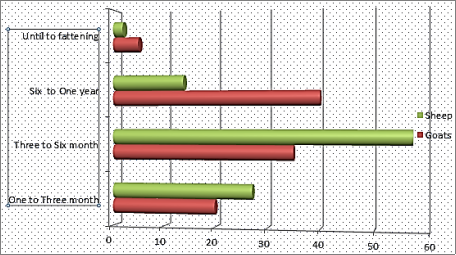
Like any other extensive traditional fattening system, sheep were supplemented with leaves of various multi-purpose tree species like bamboo, suspania and grain from food crop during the dry season (Figure 2).
About 27.2%, 57%, 13.9% and 1.9% of the respondents fattened sheep for 1 to 3, 4-6, 6 months to 1 year, respectively. Majority of households fed their small ruminants for as long period as 4-6 months. This is probably due to their limited knowledge on cost benefit analysis and the low value feed used for fattening. The feeding system of most (64%) householder were based on grazing combined with stall feeding and browse different forage species; in which small ruminant spend most of the time in the day on pasture lands and are supplied with grains from food crop and/or other supplements as available during morning and evening. The remaining small proportions (20%) totally depend on improved forage grazing and shrubs.
Figure 2. Seasonal fattening of small ruminants.
3.10. Challenges and Opportunity in Study Areas
The pronounced constraints in study area in relation to small ruminant fattening were observed to be Shortage of feed, which is directly related to decreasing farm size. This ranked as the number one constraint by most of the respondents in study area (Table 10). Following this, lack of space for small ruminant husbandry, diseases, knowledge gap, management problems, Market problem, and others were the Second, third, fourth, fifth, sixth and seventh ranked constraints in study area. There was similar reports to these founding that show lack of feed, disease, water shortage, predators and others are main constraints in Kofole and Adilo areas .
Even though, small ruminant fattening has contributions to socio-economic development of producers, the participation of smallholder farmers in the fattening activity is yet traditional and hindered by many challenges. Thus, this study indicated that small ruminant production and productivity were very low and producers may not get reasonable benefits from their fattening activity (Table 10). According to the interviewed producers, shortage of feed is the major constraint ranked as 1st with the index value of 0.209 followed by disease (2nd), knowledge and extension gap (3rd), management problem, (4th) marketing (5th), shortage of land (6th) and others (7th rank) with an index value of 0.184, 0.168, 0.158, 0.146, 0.074 and 0.058 respectively.
Table 10. Rank of constraints of small ruminant fattening activity.

Respondents rank

Constraint’s

1st

2nd

3rd

4th

5th

6th

7th

Index

Shortage of feed

48

39

27

23

12

7

2

0.209

Disease

32

47

17

12

23

14

13

0.184

Knowledge and extension gap

-

59

43

7

20

11

6

0.168

Management problem

41

36

25

-

-

6

5

0.158

Market problem

17

21

17

34

29

13

16

0.146

Shortage of land

43

21

12

20

9

16

37

0.074

Others¥

-

23

10

6

7

-

4

0.058

Index=sum of all single constraint rank [(7 for 1) + (6 for 2) + (5 for 3) + (4 for 4) + (3 for 5) + (2 for 6) + (1 for 7)] divided by sum of all weighed or raised constraint.
¥ Includes lack of money and predators.
4. Conclusion
This study was evaluate tradition fattening practice, availability (management, housing, feed resources, feeding system, watering and constraints) and major feed resource for small ruminants. Small ruminant fattening was a common practice in the study area. The fattening system in the study area was more of extensive system. The majority of the sheep and goats owning households were male headed while only small proportions were headed by females as 85.4% and 14.6% respectively. The major people in study districts have education of primary to higher level (54.4%) and the remained 45.6% were illiterate. The major feed resources available in the district were natural pasture, Desho grass different parts of enset, bamboo leaf and crop residues. The study area dominated by extensive management system. 69% percent of the households in study site indicated that they usually tether their small ruminants particularly during the cropping season in order to minimize conflicts with adjacent farm owners as a result of crop damage. Since grazing alone could not meet the nutrient requirements of their small ruminants, a few respondents in study areas indicate that the supplementation of at least a part of their flock during the dry season. Bamboo as one of the most versatile, fast growing and evergreen plant that play ample role, used as supplemental feed in the traditional fattening practice.
Abbreviations

CSA

Central Statistical Authority

FGD

Focus Group Discussion

HH

House Holder

Author Contributions
Kedir Adem is the sole author. The author read and approved the final manuscript.
Conflicts of Interest
The author declares no conflicts of Interest.
References
[1] Thornton, P. K. (2010) Review Livestock Production: Recent Trends, Future Prospects. Philosophical Transactions of the Royal Society B: Biological Sciences, 365, 2853-2867.
[2] Birhanu Gebremariam, 2006. Commercialization of Ethiopian agriculture. Extension service from input supplier to knowledge broker and facilitator.
[3] Solomon, G. (2003). Sheep and goat production and marketing systems in Ethiopia: Characteristics and strategies for improvement (Vol. 23). ILRI (aka ILCA and ILRAD).
[4] Negassa, A., and M. Jabbar. (2008). Livestock ownership, commercial off-take rates and their determinants in Ethiopia. Research Report 9. Nairobi, Kenya: International Livestock Research Institute (ILRI).
[5] Central Statistics Agency (CSA, 2020). Agricultural sample survey. Livestock and livestock characteristic report (Private Peasant Holdings). April, Addis Ababa, Ethiopia.
[6] Aune, J. B., Bussa, M. T., Asfaw, F. G. and Ayele, A. A, (2001). The ox ploughing system in Ethiopia: can it be sustained? Outlook on Agriculture 30: 275–280.
[7] Adane Hirpa and Girma Abebe, (2008). Economic significance of Sheep and Goats. pp. 2-24. Sheep and Goat production hand book for Ethiopia. ESGPIP (Etiopian Sheep and Goats productivity improvement program. Adis Ababa, Ethiopia.
[8] Azage T., (2006). Institutional arrangement and challenges in market oriented livestock agriculture in Ethiopia. Society’s animal production held in Addis Ababa September, 5/7/2006. ESAP 9: 10-12.
[9] Shapiro, B. I., Mohamed-Saleem, M. A. and L. Reynolds., (1993). Socio-economic constraints to strategic sheep fattening: evidence from the Ethiopian highlands. In Lebbie S. H. B., Rey B. and Irungu E K. Small Ruminant Research and Development in Africa. Addis Ababa: ILCA.
[10] Sidama Zone Planning and Economic Development Department (SZPEDD) (2010). Sidama Administrative zone: A socio-economic profile. Awassa, Ethiopia.
[11] Yamane, Y. (1967). Mathematical Formulae for Sample Size Determination.
[12] CSA (Central Statistical Authority), (2015). Agriculture sample survey agricultural sample servey livestock and livestock characteristics (private peasant holdind), Ethiopia.
[13] Hizkel K., Yoseph M. and Yosef T. (2018) Husbandry and Breeding Practices of Indigenous Sheep in Bensa District of Sidama Zone, Southern Region. East African Journal of Veterinary and Animal Sciences, 2 (1): 27-34.
[14] Endale Amare, Claire Mouquet-Rivier, Adrien Servent, Gilles Morel, Abdulaziz Adish, Gulelat Desse Haki. Food and Nutrition Sciences Vol. 6 No. 1, January 12, 2015.
[15] Bedasa E (2012). Study of Smallholder Farms Livestock Feed Sourcing and Feeding Strategies and their Implication on Livestock Water Productivity in Mixed Crop-Livestock Sub systems in the Highlands of the Blue Nile Basin, Ethiopia. MSc. thesis Submitted to the School of Graduate Studies. Haramaya University. 139 p.
[16] Guyo Demisse, et., al, (2016). Assessment of fattening and marketing system, and effect of concentrate supplementation with locally available feeds on fattening performance of indigenous cattle in bonke woreda of Gamo gofa zone, Southern Ethiopia.
[17] Selamawit, D. and Matiwos, H. (2015). Sheep and goat production practice in agroforestry systems of Gedio Zone, Ethiopia. International Journal of Environment, 4(2), pp. 296-307.
[18] Abera Anja and Elias Hesebo (2019). Sheep Fattening Practices and Constraints in East Badewacho Woreda, Hadiya Zone Southern Ethiopia 21(3): 109-115.
[19] Deribe, G. (2009) On-Farm Performance Evaluation of Indigenous Sheep and Goats in Alaba, Southern Ethiopia. MSc Thesis, Hawassa University, Awassa.
[20] Kassahun, A. (2011) Assessment of Camel Production Practices in Berhale Woreda, Afar Region. M.Sc. Thesis, Haramaya University, Haramaya, Ethiopia.
[21] Teshager A, Belay D and Taye T (2013). Smallholder cattle milk production, utilization and marketing pattern in different agro-ecological districts of Ilu Aba Bora Zone, Southwestern Ethiopia. American-Eurasian Journal of ScientificResearch, 8(1): 24-30.
[22] Abule E, (2003). Rangeland evaluation in relation to pastoralists perceptions in the Middle Awash Valley of Ethiopia. A PhD thesis Presented to the University of the Free State, Bloemfontein, South Africa. 297p.
[23] Zewudu, E. (2008) Characterization of Bonga and Horro Indigenous Sheep Breeds of Smallholders for Designing Community Based Breeding Strategies in Ethiopia. M.Sc. Thesis, School of Graduate Studies of Haramaya University, Dire Dawa.
[24] Tesfaye, A., et al. (2008) The Impact of Small-Scale Irrigation on Household Food Security: The Case of Filtino and Godino Irrigation Schemes in Ethiopia. Irrigation and Drainage Systems, 22, 145-158.
[25] Belete Shenkute., (2009). Production and marketing systems of small ruminants in Goma district of Jimma zone, western Ethiopia. An M. Sc. Thesis, Hawassa University, Ethiopia.
[26] Legesse Y., Tegegn, A., Belachew, T. and Tushune, K. (2007) Knowledge, attitude and practice about malaria transmission and its preventive measures among house- holds in urban areas of Assosa Zone, western Ethiopia. Ethiopian Journal of Health Development, 21(2), 157-165.
Cite This Article
  • APA Style

    Adem, K. (2024). Major Feed Resources for Small Ruminant and Traditional Feding Practice in Bursa District of Sidama Region, Ethiopia. Animal and Veterinary Sciences, 12(6), 161-170. https://doi.org/10.11648/j.avs.20241206.13

    Copy | Download

    ACS Style

    Adem, K. Major Feed Resources for Small Ruminant and Traditional Feding Practice in Bursa District of Sidama Region, Ethiopia. Anim. Vet. Sci. 2024, 12(6), 161-170. doi: 10.11648/j.avs.20241206.13

    Copy | Download

    AMA Style

    Adem K. Major Feed Resources for Small Ruminant and Traditional Feding Practice in Bursa District of Sidama Region, Ethiopia. Anim Vet Sci. 2024;12(6):161-170. doi: 10.11648/j.avs.20241206.13

    Copy | Download

  • @article{10.11648/j.avs.20241206.13,
      author = {Kedir Adem},
      title = {Major Feed Resources for Small Ruminant and Traditional Feding Practice in Bursa District of Sidama Region, Ethiopia
    },
      journal = {Animal and Veterinary Sciences},
      volume = {12},
      number = {6},
      pages = {161-170},
      doi = {10.11648/j.avs.20241206.13},
      url = {https://doi.org/10.11648/j.avs.20241206.13},
      eprint = {https://article.sciencepublishinggroup.com/pdf/10.11648.j.avs.20241206.13},
      abstract = {The study was conducted in Bursa districts of the highland areas of Sidama region to Evaluate traditional fattening practice, and availability of major feed resources for small ruminants. For the survey, 92 households were randomly selected by using multi-stage purpose sampling techniques. The survey data were collected on fattening practices, feed availability and constraints related to small ruminant fattening by using structured questionnaires’, field observation, focal group discussion and key informant interviews. Secondary information was obtained from respective districts of livestock development offices. According to the results this study, the major sources of small ruminant for fattening were obtained through purchasing (63.9%) followed by own at home (36.1%) and majority of the farmers fatten small ruminant twice within a year (47%) in 4-6 months (63%). The major available feed resources for small ruminant in the study area were natural pasture, Desho grass, bamboo leaf, enset leaf and barely straw. According to most respondents, the shortage of feed occurred from January to March, While, July to October was considered as months with ample feed resources.
    },
     year = {2024}
    }
    

    Copy | Download

  • TY  - JOUR
    T1  - Major Feed Resources for Small Ruminant and Traditional Feding Practice in Bursa District of Sidama Region, Ethiopia
    
    AU  - Kedir Adem
    Y1  - 2024/12/23
    PY  - 2024
    N1  - https://doi.org/10.11648/j.avs.20241206.13
    DO  - 10.11648/j.avs.20241206.13
    T2  - Animal and Veterinary Sciences
    JF  - Animal and Veterinary Sciences
    JO  - Animal and Veterinary Sciences
    SP  - 161
    EP  - 170
    PB  - Science Publishing Group
    SN  - 2328-5850
    UR  - https://doi.org/10.11648/j.avs.20241206.13
    AB  - The study was conducted in Bursa districts of the highland areas of Sidama region to Evaluate traditional fattening practice, and availability of major feed resources for small ruminants. For the survey, 92 households were randomly selected by using multi-stage purpose sampling techniques. The survey data were collected on fattening practices, feed availability and constraints related to small ruminant fattening by using structured questionnaires’, field observation, focal group discussion and key informant interviews. Secondary information was obtained from respective districts of livestock development offices. According to the results this study, the major sources of small ruminant for fattening were obtained through purchasing (63.9%) followed by own at home (36.1%) and majority of the farmers fatten small ruminant twice within a year (47%) in 4-6 months (63%). The major available feed resources for small ruminant in the study area were natural pasture, Desho grass, bamboo leaf, enset leaf and barely straw. According to most respondents, the shortage of feed occurred from January to March, While, July to October was considered as months with ample feed resources.
    
    VL  - 12
    IS  - 6
    ER  - 

    Copy | Download

Author Information
  • Abstract
  • Keywords
  • Document Sections

    1. 1. Introduction
    2. 2. Materials and Methods2.1. Description of the Study Area
    3. 3. Result and Discussion
    4. 4. Conclusion
    Show Full Outline
  • Abbreviations
  • Author Contributions
  • Conflicts of Interest
  • References
  • Cite This Article
  • Author Information