
In Nigeria, sheep pox and goat pox is a major problem. Sheep pox and goat pox diseases are highly contagious viral diseases of small ruminants caused by a virus of the Capripox genus. This study was aimed to comparatively evaluate the clinico-pathological changes in sheep and goats manifesting the clinical cases of the diseases. The design of the study was a cross sectional survey. A total of 166 sheep (66) and goats (100) were sampled purposively. Three millilitres of blood sampled was collected from the external jugular vein of affected and apparently healthy sheep and goats used for haematological analyses. Real-Time Polymerase Chain Reaction (RT-PCR) was used to confirm the presence of sheeppox and/or goatpox virus in 34 scrapped skin scrapings collected from sheep (14 samples) and goats (20 samples) that showed the characteristic of pock lesions. Dead sheep and goats were necropsied and fixed in 10% neutral-buffered formalin and were routinely processed for histopathology. Clinical signs observed were fever (high rectal temperatures of 40 to 41.5°C in sheep and 38 to 40°C in goats), papules, and abortion in goats among others. The mean PCV value of sheep and goats with pock lesions (24.07±5.36%) and (27.63±5.24%), respectively were significantly lower than those of apparently healthy sheep (33.09±4.24%) and goats (31.66±2.7%). The mean HBC value of sheep and with pock lesions (8.80±2.49g/dl) was significantly lower than those of apparently sheep (11.30±1.62g/dl), while there was no significant difference between the HBC of goats with pock lesions (12.78±2.81g/dl) and apparently healthy goats (11.91±1.14g/dl). The mean RBC of sheep value (6.46±2.55×10¹²/L) was significantly lower than that of apparently healthy sheep (9.06±2.24 x 10¹²/L), The mean values for WBC count, absolute neutrophils and lymphocyte were also affected. Of the 34 skin samples collected and analyzed for the presence of sheep/goat pox viruses, 30 (88.2%) yielded positive using universal Capripox primers. Of the 30 positive samples, 21 were further subjected to sheep pox specific primers, 18 (85.7%) positive were obtained for sheeppox specific primers and no sample yielded positive result to goat specific primers. Overall, 88.2% of sheep and goat populations showing pock lesions were confirmed for sheeppox. The results of this study suggest that sheeppox virus was responsible for the disease outbreaks in sheep and goats from the study areas. Sheep pox disease has the potential of causing significant alteration in the hematological parameters resulting in anemia and immunosuppression. Yearly vaccination of sheep and goats is therefore recommended.
| Published in | Animal and Veterinary Sciences (Volume 14, Issue 2) |
| DOI | 10.11648/j.avs.20261402.11 |
| Page(s) | 25-35 |
| Creative Commons |
This is an Open Access article, distributed under the terms of the Creative Commons Attribution 4.0 International License (http://creativecommons.org/licenses/by/4.0/), which permits unrestricted use, distribution and reproduction in any medium or format, provided the original work is properly cited. |
| Copyright |
Copyright © The Author(s), 2026. Published by Science Publishing Group |
Sheep, Goat, Pox, Virus, Bauchi, Gombe, North-East, Capripox, Immunosuppression
Clinical signs | Sheep | Goats |
|---|---|---|
Rectal temperature | 40-41.5°C | 38-40°C |
In-appetence | Present | Present |
Emaciation | Present | Present |
Lethargic | Present | Present |
Difficulty in breathing | Present | Present |
Ocular discharges | Present | Present |
Formation of crust | Present | Present |
Dry scabs on healing wounds | Present | Present |
Ulceration | Present | Absent |
Alopecia | Present | Present |
Abortion | Absent | Present |
Body location | Sheep | Goat |
|---|---|---|
Face | ++ | ++ |
Ears | + | ++ |
Mouth (oral commissure) | ++ | +++ |
Nose | ++ | +++ |
Neck | + | ++ |
Mandible | ++ | ++ |
Limbs | ++ | ++ |
Back (dorsum) | ++ | ++ |
Tail | + | ++ |
Perineum | + | ++ |
Prepuce/testes | ++ | +++ |
Udder | ++ | +++ |
Ventral abdomen | + | ++ |
Lateral abdomen | ++ | ++ |
Inner thigh | ++ | ++ |
Lateral thigh | ++ | ++ |
Body location/organ | Sheep | Goat |
|---|---|---|
Skin | + | ++ |
Nasal block with thick mucoid exudates | ++ | ++ |
Swollen lymphnode | ++ | ++ |
Engorged gallbladder | + | - |
Pale and enlarged spleen with areas of congestion | ++ | ++ |
Congestion of the lungs | + | ++ |
Ocular discharges | - | + |
Congested and swollen liver | + | ++ |
Hyperaemia of the rumen and reticulum | - | + |
Frothy exudates in the entire trachea down to the alveoli | - | ++ |
Congested areas of the intestinal mucosae | - | +++ |
Flabby cardiac musculature | + | ++ |
Congested kidney | - | ++ |
Hyperaemic areas on the gum | - | + |
Parameters | Mean±SD | Pvalue (2-tailed) | |
|---|---|---|---|
Healthy | Poxvirus infected sheep | ||
PCV (%) | 33.09±4.24 | 24.07±5.36 | 0.001 |
HbC (g/dL) | 11.30±1.62 | 8.80±2.49 | 0.020 |
RBC Count (×1012/L) | 9.06±2.24 | 6.46±2.55 | 0.030 |
MCV (FL) | 37.4 | 37.3 | 0.00 |
MCHC (g/dL) | 34.1 | 36.6 | 0.00 |
MCH (pg) | 12.5 | 13.2 | 0.00 |
Total WBC Count (×109/L) | 15.76±5.74 | 5.72±4.20 | 0.002 |
Neutrophils Count (×109/L) | 7.62±2.99 | 3.14±3.01 | 0.007 |
Lymphocytes Count (×109/L) | 8.27±3.74 | 2.72±1.78 | 0.007 |
Parameters | Mean±SD | P value (2-tailed) | |
|---|---|---|---|
Healthy | Poxvirus infected goats | ||
PCV (%) | 31.66±2.70 | 27.62±5.24 | 0.019 |
HbC (g/dL) | 11.91±1.14 | 12.78±2.81 | 0.274 |
RBC Count (×1012/L) | 6.22±1.85 | 5.63±1.53 | 0.469 |
MCV (FL) | 50.9 | 49.1 | 0.00 |
MCHC (g/dL) | 35.4 | 46.3 | 0.00 |
MCH (pg) | 19.1 | 22.7 | 0.00 |
Total WBC Count (×109/L) | 15.65±3.92 | 7.15±3.28 | 0.001 |
Neutrophils Count (×109/) | 6.61±3.10 | 3.26±1.64 | 0.029 |
Lymphocytes Count (×109/) | 8.84±2.88 | 3.82±2.35 | 0.020 |
Animal specie | Bauchi | Gombe | Total |
|---|---|---|---|
Sheep | 5 (14.7%) | 7 (20.6%) | 12 (35.3%) |
Goat | 8 (23.5%) | 10 (29.4%) | 18 (52.9%) |
Total | 13 (38.2%) | 17 (50%) | 30 (88.2%) |
WOAH | World Organization for Animal Health |
SPV | Sheep Pox Virus |
GPV | Goat Pox Virus |
PCR | Polymerase Chain Reaction |
OIE | International des Epizooties |
NVRI | National Veterinary Research Institute |
SGP | Sheep and Goat Pox |
EDTA | Ethylene Diamine Tetraaceticacid |
PVC | Park Cell Volume |
RBC | Red Blood Count |
WBC | White Blood Count |
DLC | Differential Leucocyte Count |
HBC | Haemoglobin Concentration |
| [1] | Abd-Elfatah, E. B., El-Mekkawi, M. F., Bastawecy, I. M., &Fawzi, E. M. (2018). Identification and phylogenetic analysis of sheep pox during an outbreak of sheep in Sharkia Governorate, Egypt. Genetics and Molecular Research, 17(2). |
| [2] | Abdel-Ghaffar, K. H. S., &Hassanein, K. M. A. (2009, October). Pathological study of malignant form of sheep pox. In 10th Scientific Congress of Cattle Diseases. Faculty of Veterinary Medicine, Assiut University, Assiut, Egypt. |
| [3] | Abubakar, M., Mahapatra, M., Muniraju, M., Arshed, M. J., Khan, E. H., Banyard, A. C., &Parida, S. (2015). Peste des petitsruminants virus, Asia and Africa. Emerging Infectious Diseases, 21(2), 202–208. |
| [4] | Achour, H. A., Bonguedour, R., Bouhbal, A., &Guechtouli, A. (2000). Comparative study of immunizing ability of some attenuated strains of sheeppox virus and sensitizing vaccine. Revue Scientifiqueet Technique (International Office of Epizootics), 19(3), 773–783. |
| [5] | Adedeji, A. J., Moller, J., Meseko, C. A., Adole, J. A., Tekki, I. S., Shamaki, D., & Hoffmann, B. (2019). Molecular characterization of capripoxviruses obtained from field outbreaks in Nigeria between 2000 and 2016. Transboundary and Emerging Diseases, 66(3), 1629–1641. |
| [6] | Aswini, B. S. (2015). Pathological and molecular diagnosis of sheep pox (Master’s thesis). Sri Venkateswara Veterinary University, Tirupati, Andhra Pradesh, India. |
| [7] | Babiuk, S., Bowden, T. R., Boyle, D. B., Wallace, D. B., &Kitching, R. P. (2008). Capripoxviruses: An emerging worldwide threat to sheep, goats, and cattle. Transboundary and Emerging Diseases, 55(7), 263–272. |
| [8] | Balamurugan, V., Krishnamoorthy, P., Raju, D. S., Kumanan, K., Raj, G. D., Nachimuthu, K. & Singh, R. K. (2014). Capripox: An emerging and re-emerging zoonosis in India. VirusDisease, 25(4), 398–404. |
| [9] | Dar, L. M., Darzi, M. M., Mir, M. S., Kamil, S. A., Rashid, A., Abdullah, S., Hussain, S. A., &Bhat, A. A. (2012). Sheep pox virus induced interstitial pneumonia in sheep. International Journal of Livestock Research, 2(2), 159–164. |
| [10] | Das, A., Babiuk, S., & McIntosh, M. T. (2012). Development of loop-mediated isothermal amplification assay for rapid detection of capripoxviruses. Journal of Clinical Microbiology, 50(5), 1613–1620. |
| [11] | Diallo, A., Taylor, W. P., Lefèvre, P. C., & Provost, A. (1989). Attenuation of capripoxvirus isolates. Research in Veterinary Science, 47(2), 243–248. |
| [12] | Embury-Hyatt, C., Babiuk, S., Manning, L., Ganske, S., Bowden, T. R., Boyle, D. B., &Copps, J. (2012). Pathology and viral antigen distribution following experimental infection of sheep and goats with capripoxvirus. Journal of Comparative Pathology, 146(2–3), 106–115. |
| [13] | Gambo, P., Maguda, A. S., Adole, J. A., Dyek, D. Y., Ifende, V. I., Bot, C., &Adedeji, A. J. (2018). A survey of viral diseases of livestock characterized by skin lesions in Kanam Local Government Area of Plateau State, Nigeria. Nigerian Veterinary Journal, 39(3), 250–262. |
| [14] | Geleye, E., Lamien, C. E., Silber, R., Tuppurainen, E. S., Grabber, R., & Diallo, A. (2013). Development of a cost-effective method for capripoxvirus genotyping using snapback primer and dsDNA intercalating dye. PLOS ONE, 8(10), e75971. |
| [15] | Hopwood, D. (1996). Fixation and fixatives. In J. Bancroft & A. Stevens (Eds.), Theory and practice of histological techniques (pp. 23–46). New York, NY: Churchill Livingstone. |
| [16] | Jayasri, K. (2015). Pathological and molecular diagnosis of goatpox (Master’s thesis). Sri Venkateswara Veterinary University, Tirupati, Andhra Pradesh, India. |
| [17] | Joshi, R. K., Chandra, R., Rao, V. D. P., &Garg, S. K. (1992). Goatpox: A review. Journal of Applied Animal Research, 2(1), 57–72. |
| [18] | Lamien, C. E., Lelenta, M., Goger, W., Silber, R., Tuppurainen, E., Matijevic, M.,...& Diallo, A. (2011). Real-time PCR method for simultaneous detection, quantitation and differentiation of capripoxviruses. Journal of Virological Methods, 171(1), 134–140. |
| [19] | Limon, G., Gamawa, A. A., Ahmed, A. I., Lyons, N. A., & Beard, P. M. (2020). Epidemiological characteristics and economic impact of lumpy skin disease, sheeppox, and goatpox among subsistence farmers in northeast Nigeria. Frontiers in Veterinary Science, 7, 8. |
| [20] | Masoud, F., Mahmood, M. S., &Hussain, I. (2016). Sero-epidemiology of goatpox disease in District Layyah, Punjab, Pakistan. Journal of Veterinary Medicine and Research, 3(1), 1043. |
| [21] | Mirzaie, K., Barani, S. M., &Bokaie, S. (2015). A review of sheeppox and goatpox: Perspective of their control and eradication. Journal of Advanced Veterinary and Animal Research, 2(4), 373–381. |
| [22] |
OIE. (2019). Sheep pox and goat pox. In Manual of diagnostic tests and vaccines for terrestrial animals (Chapter 3.7.10). World Organisation for Animal Health. Retrieved from
https://www.oie.int/manual-of-diagnostic-tests-and-vaccines-for-terrestrial-animals/ |
| [23] | Pawaiya, R. V. S., Bhagwan, S. K., &Dubey, S. C. (2008). Histo-pathological study of goat pox in a natural outbreak. Indian Journal of Small Ruminants, 14(2), 266–270. |
| [24] | Rao, T., &Bandyopadhyay, S. (2000). A comprehensive review of goat pox and sheep pox and their diagnosis. Animal Health Research Reviews, 1(2), 127–136. |
| [25] | Sajid, A., Chaudhary, Z. I., Sadique, U., Maqbol, A., Anjum, A. A., Muhammad, Qureshi, S., Hassan, Z. U., Idress, M., &Shahid, M. (2012). Prevalence of goat pox disease in Punjab Province of Pakistan. The Journal of Animal and Plant Sciences, 22(2), 28–32. |
| [26] | Sharma, S., Nashiruddullah, N., & Ahmed, J. A. (2020). Pathology of spontaneous pox virus infection of sheep and goat in Jammu Region. International Journal of Current Microbiology and Applied Sciences, 9(6), 1204–1226. |
| [27] | Singh, R., Chandra, D., Singh, K. P., Hosamani, M., Singh, R. K., & Chauhan, R. S. (2007). Epidemiological investigation of sheep pox outbreaks in Rajasthan, India. Indian Journal of Veterinary Pathology, 31(2), 712–715. |
| [28] | Thrall, M. A., & Weiser, M. G. (2002). Hematology. In C. M. Hendrix (Ed.), Laboratory procedures for veterinary technicians (4th ed., pp. 29–74). Mosby Inc. |
| [29] | Trang, H. P., Lila, M. A. M., Rahaman, N. Y. A., Lai, H. L. T., Nguyen, L. T., Do, K. V., &Noordin, M. M. (2020). Epidemiology and clinic-pathological characteristics of current goat pox outbreak in North Vietnam. BMC Veterinary Research, 16, 128. |
| [30] | Tuppurainen, E. S. M., Venter, E. H., Shisler, J. L., Gari, G., Mekonnen, G. A., Juleff, N.,... &Babiuk, L. A. (2017). Capripoxvirus diseases: Current status and opportunities for control. Transboundary and Emerging Diseases, 64(3), 729–745. |
| [31] | Verma, S., Verma, L. K., Gupta, V. K., Katoch, V. C., Dogra, V., Pal, B., & Sharma, M. (2011). Emerging capripoxvirus disease outbreak in Himachal Pradesh, a northern state of India. Transboundary and Emerging Diseases, 58(1), 79–85. |
| [32] | Wolff, J., Beer, M., & Hoffmann, B. (2021). Probe-based real-time assay for a reliable differentiation of capripoxvirus species. Microorganisms, 9(4), 765. |
| [33] | World Organisation for Animal Health. (2012). Manual of diagnostic tests and vaccines for terrestrial animals. Paris, France: OIE. |
| [34] | World Organisation for Animal Health. (2012). Terrestrial animal health code. Paris, France: OIE. |
APA Style
Emmanuel, L. L., Chuka, A. D., Adedeji, A., Ezema, A. S., Bako, M. J., et al. (2026). Comparative Clinicopathologic Studies on Sheep Pox and Goat Pox in Bauchi and Gombe of North-Eastern Nigeria. Animal and Veterinary Sciences, 14(2), 25-35. https://doi.org/10.11648/j.avs.20261402.11
ACS Style
Emmanuel, L. L.; Chuka, A. D.; Adedeji, A.; Ezema, A. S.; Bako, M. J., et al. Comparative Clinicopathologic Studies on Sheep Pox and Goat Pox in Bauchi and Gombe of North-Eastern Nigeria. Anim. Vet. Sci. 2026, 14(2), 25-35. doi: 10.11648/j.avs.20261402.11
@article{10.11648/j.avs.20261402.11,
  author = {Logyang Lot Emmanuel and Anyogu Davinson Chuka and Adeyinka Adedeji and Arinzechukwu Stephen Ezema and Mafulul Joshua Bako and Bolajoko Mohammed Bashiru and Shuaibu Rabiata Haruna and Idoko Felix and Choji Tobias Peter Pwajok and Maguda Adrian and Moses Gyang Davou and Chah Kennedy and Shoyinka Vincent},
  title = {Comparative Clinicopathologic Studies on Sheep Pox and Goat Pox in Bauchi and Gombe of North-Eastern Nigeria},
  journal = {Animal and Veterinary Sciences},
  volume = {14},
  number = {2},
  pages = {25-35},
  doi = {10.11648/j.avs.20261402.11},
  url = {https://doi.org/10.11648/j.avs.20261402.11},
  eprint = {https://article.sciencepublishinggroup.com/pdf/10.11648.j.avs.20261402.11},
  abstract = {In Nigeria, sheep pox and goat pox is a major problem. Sheep pox and goat pox diseases are highly contagious viral diseases of small ruminants caused by a virus of the Capripox genus. This study was aimed to comparatively evaluate the clinico-pathological changes in sheep and goats manifesting the clinical cases of the diseases. The design of the study was a cross sectional survey. A total of 166 sheep (66) and goats (100) were sampled purposively. Three millilitres of blood sampled was collected from the external jugular vein of affected and apparently healthy sheep and goats used for haematological analyses. Real-Time Polymerase Chain Reaction (RT-PCR) was used to confirm the presence of sheeppox and/or goatpox virus in 34 scrapped skin scrapings collected from sheep (14 samples) and goats (20 samples) that showed the characteristic of pock lesions. Dead sheep and goats were necropsied and fixed in 10% neutral-buffered formalin and were routinely processed for histopathology. Clinical signs observed were fever (high rectal temperatures of 40 to 41.5°C in sheep and 38 to 40°C in goats), papules, and abortion in goats among others. The mean PCV value of sheep and goats with pock lesions (24.07±5.36%) and (27.63±5.24%), respectively were significantly lower than those of apparently healthy sheep (33.09±4.24%) and goats (31.66±2.7%). The mean HBC value of sheep and with pock lesions (8.80±2.49g/dl) was significantly lower than those of apparently sheep (11.30±1.62g/dl), while there was no significant difference between the HBC of goats with pock lesions (12.78±2.81g/dl) and apparently healthy goats (11.91±1.14g/dl). The mean RBC of sheep value (6.46±2.55×10¹²/L) was significantly lower than that of apparently healthy sheep (9.06±2.24 x 10¹²/L), The mean values for WBC count, absolute neutrophils and lymphocyte were also affected. Of the 34 skin samples collected and analyzed for the presence of sheep/goat pox viruses, 30 (88.2%) yielded positive using universal Capripox primers. Of the 30 positive samples, 21 were further subjected to sheep pox specific primers, 18 (85.7%) positive were obtained for sheeppox specific primers and no sample yielded positive result to goat specific primers. Overall, 88.2% of sheep and goat populations showing pock lesions were confirmed for sheeppox. The results of this study suggest that sheeppox virus was responsible for the disease outbreaks in sheep and goats from the study areas. Sheep pox disease has the potential of causing significant alteration in the hematological parameters resulting in anemia and immunosuppression. Yearly vaccination of sheep and goats is therefore recommended.},
 year = {2026}
}
TY  - JOUR
T1  - Comparative Clinicopathologic Studies on Sheep Pox and Goat Pox in Bauchi and Gombe of North-Eastern Nigeria
AU  - Logyang Lot Emmanuel
AU  - Anyogu Davinson Chuka
AU  - Adeyinka Adedeji
AU  - Arinzechukwu Stephen Ezema
AU  - Mafulul Joshua Bako
AU  - Bolajoko Mohammed Bashiru
AU  - Shuaibu Rabiata Haruna
AU  - Idoko Felix
AU  - Choji Tobias Peter Pwajok
AU  - Maguda Adrian
AU  - Moses Gyang Davou
AU  - Chah Kennedy
AU  - Shoyinka Vincent
Y1  - 2026/04/16
PY  - 2026
N1  - https://doi.org/10.11648/j.avs.20261402.11
DO  - 10.11648/j.avs.20261402.11
T2  - Animal and Veterinary Sciences
JF  - Animal and Veterinary Sciences
JO  - Animal and Veterinary Sciences
SP  - 25
EP  - 35
PB  - Science Publishing Group
SN  - 2328-5850
UR  - https://doi.org/10.11648/j.avs.20261402.11
AB  - In Nigeria, sheep pox and goat pox is a major problem. Sheep pox and goat pox diseases are highly contagious viral diseases of small ruminants caused by a virus of the Capripox genus. This study was aimed to comparatively evaluate the clinico-pathological changes in sheep and goats manifesting the clinical cases of the diseases. The design of the study was a cross sectional survey. A total of 166 sheep (66) and goats (100) were sampled purposively. Three millilitres of blood sampled was collected from the external jugular vein of affected and apparently healthy sheep and goats used for haematological analyses. Real-Time Polymerase Chain Reaction (RT-PCR) was used to confirm the presence of sheeppox and/or goatpox virus in 34 scrapped skin scrapings collected from sheep (14 samples) and goats (20 samples) that showed the characteristic of pock lesions. Dead sheep and goats were necropsied and fixed in 10% neutral-buffered formalin and were routinely processed for histopathology. Clinical signs observed were fever (high rectal temperatures of 40 to 41.5°C in sheep and 38 to 40°C in goats), papules, and abortion in goats among others. The mean PCV value of sheep and goats with pock lesions (24.07±5.36%) and (27.63±5.24%), respectively were significantly lower than those of apparently healthy sheep (33.09±4.24%) and goats (31.66±2.7%). The mean HBC value of sheep and with pock lesions (8.80±2.49g/dl) was significantly lower than those of apparently sheep (11.30±1.62g/dl), while there was no significant difference between the HBC of goats with pock lesions (12.78±2.81g/dl) and apparently healthy goats (11.91±1.14g/dl). The mean RBC of sheep value (6.46±2.55×10¹²/L) was significantly lower than that of apparently healthy sheep (9.06±2.24 x 10¹²/L), The mean values for WBC count, absolute neutrophils and lymphocyte were also affected. Of the 34 skin samples collected and analyzed for the presence of sheep/goat pox viruses, 30 (88.2%) yielded positive using universal Capripox primers. Of the 30 positive samples, 21 were further subjected to sheep pox specific primers, 18 (85.7%) positive were obtained for sheeppox specific primers and no sample yielded positive result to goat specific primers. Overall, 88.2% of sheep and goat populations showing pock lesions were confirmed for sheeppox. The results of this study suggest that sheeppox virus was responsible for the disease outbreaks in sheep and goats from the study areas. Sheep pox disease has the potential of causing significant alteration in the hematological parameters resulting in anemia and immunosuppression. Yearly vaccination of sheep and goats is therefore recommended.
VL  - 14
IS  - 2
ER  -
Pathology Department, National Veterinary Research Institute, Vom, Nigeria
Department of Veterinary Pathology, University of Nigeria, Nsukka, Nigeria
Department of Veterinary Pathology, University of Nigeria, Nsukka, Nigeria
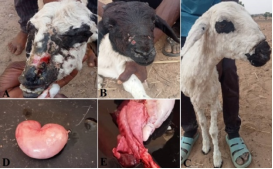
Figure 1. Some of the gross lesions observed in sheep infected with poxvirus. A-B: Alopecia, erosions, ulcerations and scar tissue formation on the face with mucopurulent nasal discharge. C: nodules underneath the skin of the face, dorsal part of the ear, neck and forelimbs. D: pale kidney. E: consolidated lungs (stage 3 consolidation or gray hepatization) with rib imprints on the costal surface.
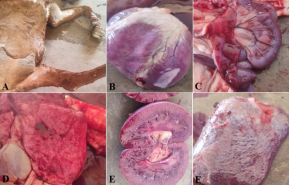
Figure 2. Some of the gross lesions observed in goats infected with poxvirus. A: nodules underneath the skin of the udder, ventral abdomen and limbs. B: patchy pale areas in the epicardium. C: Severe haemorrhage in the duodenum. D: Severely hyperaemic lung lobules. E: Kidney showing congestion of the medulla. F: Enlarged dome-shaped and mottled spleen.
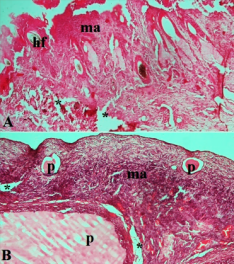
Figure 3. Skin section of sheep (A) and goat (B) infected with sheep poxvirus. Note the epidermal necrosis and sub-epidermal micro-abscesses containing predominantly mononuclear inflammatory cells, papules (p) containing hemorrhagic fluid in goat with dermal edema (asterisks), hf = hair follicle. H&E stain ×100.
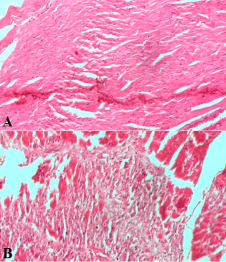
Figure 4. Heart tissue sections of sheep (A) and goat (B) infected with sheep poxvirus. Note extensive necrosis of the myofibres in (A) and moderate necrosis of the myofibres in (B). H&E stain ×200.
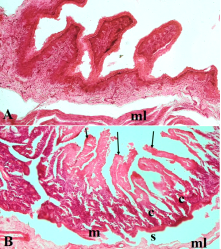
Figure 5. Intestinal sections of sheep (A) and goat (B) infected sheep poxvirus. Note severe necrosis of villi in the duodenum of goat (arrows). Ml = muscular layer, s = submucosa, m = muscularis mucosa, c = crypts. H&E stain ×100.
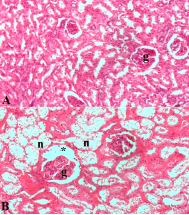
Figure 6. Kidney tissues of sheep and goat infected with sheep poxvirus. Note the severe tubular necrosis (n), atrophy of a glomerular tuft and dilation of the Bowman’s space (black asterisk), congested cortex with edema (white asterisk) in the goat, g = glomerulus. H&E stain ×200.
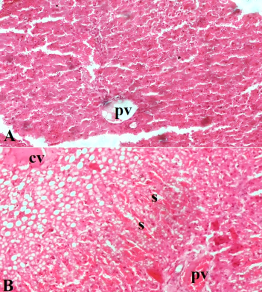
Figure 7. Liver sections of sheep (A) and goat (B) infected with sheep poxvirus. Note moderate diffuse hepatocellular necrosis in sheep and severe centrilobular vacuolar degeneration with congestion of the central vein (cv), severe sinusoidal dilation (s) and congestion of the portal vein (pv) in the goat. H&E stain ×200.
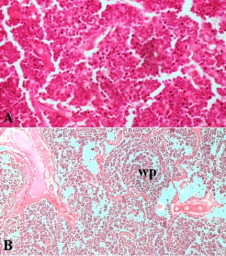
Figure 8. Splenic tissue sections of sheep (A) and goat (B) infected with sheep poxvirus. A: severe haemosiderosis in the red pulp B: severe congestion of the spleen with lymphoid depletion in the white pulp (wp). H&E stain, (A = ×400, B = ×100).
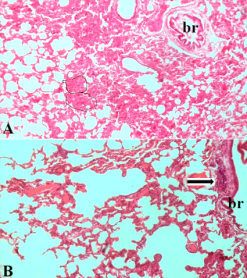
Figure 9. Lungs tissues of sheep (A) and goat (B) infected with sheep poxvirus, note severe interstitial pneumonia with formation of non-encapsulated micro-granulomas in sheep (encircled areas) composed of lymphocytes, macrophages and plasma cells. Note the peri-bronchiolar infiltrates in the goat (arrow), br = bronchiole H&E stain ×100.




 Share This Article
 Twitter
 Linked In
 Facebook
 Copy
Copy Download